Overview of Fiber Optic Cables and Fiber Optic Connectors
Definitions
Single-mode fiber: often abbreviated as SMF, is a type of optical fiber designed to transmit a single mode of light. The term “mode” refers to the electromagnetic wave patterns that the fiber can support. In the case of single-mode fiber, it allows only one mode of light to propagate through the core.
Multi-mode fiber: is abbreviated as MMF. It’s another type of optical fiber used in telecommunications and data transmission. Unlike single-mode fiber (SMF), multi-mode fiber allows the transmission of multiple modes (or paths) of light through the fiber core simultaneously. This means that multiple beams of light can travel through the core, taking different paths.
Core Diameter
The core diameter of single-mode fiber is much smaller than that of multi-mode fiber.
Single-mode Fiber: Typically, the core diameter is 9 µm (micrometers, OS2 single-mode fiber).
Multi-mode Fiber: Core diameters are 50 µm and 62.5 µm.
Fiber Outer Diameter: 125 µm
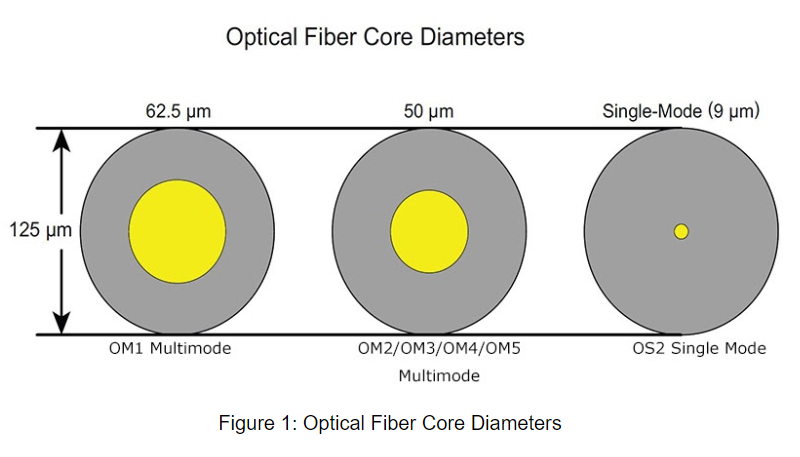
The attenuation of multi-mode fiber is much greater than that of single-mode fiber. This is because the core of single-mode fiber is very narrow, and light passing through the fiber is not reflected too many times, thereby minimizing attenuation and achieving longer transmission distances.

Wavelengths and Light Sources
Due to the larger core diameter of multi-mode fiber, some low-cost light sources such as Light Emitting Diodes (LEDs) and Vertical Cavity Surface Emitting Lasers (VCSELs) can operate within the wavelength range of 850nm to 1300nm in the fiber.
On the other hand, single-mode fiber typically utilizes lasers or laser diodes to generate light injected into the cable. Common wavelengths for single-mode fiber are in the range of 1310nm to 1550nm.
Bandwidth
The theoretical maximum bandwidth for multi-mode fiber OM5 is: 28000MHz * KM.
Single-mode fiber has theoretically unlimited bandwidth.
Outer Colors
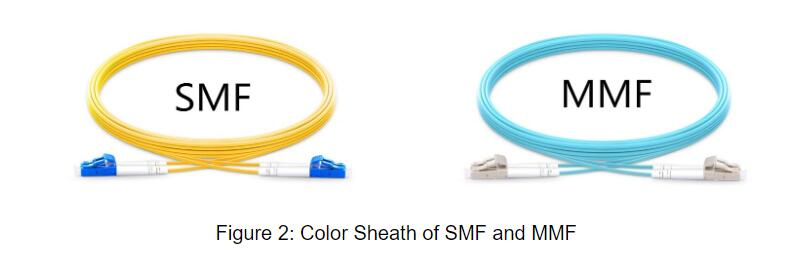
Single-mode fiber generally has a yellow outer sheath, while multi-mode fibers come in various colors.
Distance

Fiber Optic Connectors
Common Types
LC Connector
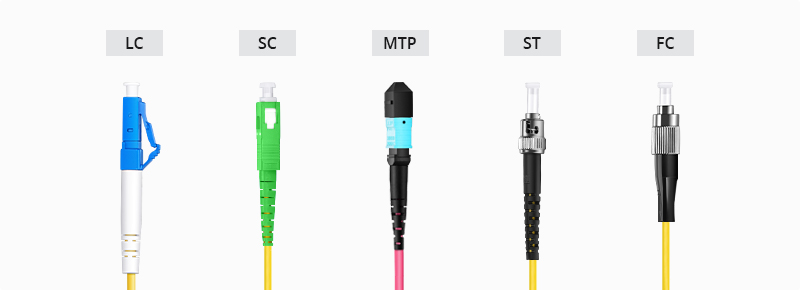
The Lucent Connector (LC) is a small form factor (SFF) fiber optic connector with a single 1.25 mm ferrule. This SFF type is widely popular in the market and is particularly suitable for high-density fiber optic environments.
SC Connector
The SC fiber optic connector was the first connector to adopt the TIA-568 standard. It is a push-pull locking connector with a square-shaped housing (hence “Square Connector”). Compared to the LC connector, the SC connector uses a 2.5 mm ferrule, which is twice the size of the LC connector.
SC connectors are well-suited for data communication and telecommunication applications, including point-to-point and passive optical networks. Due to their excellent performance, SC fiber optic connectors remain the second most common connectors in polarization-maintaining applications.
MTP/MPO Fiber Connector
Unlike the previous connectors, the MTP/MPO fiber optic connector is a multi-fiber connector that accommodates 12 to 24 fibers in a rectangular ferrule. It is often used in 40G and 100G high-bandwidth optical parallel connections (bidirectional).
The MTP/MPO fiber connector introduces complexity with its key-up/key-down, male, and female designations.
ST Connector
The Straight Tip (ST) fiber optic connector was created by AT&T shortly after the introduction of the FC connector. The ST connector secures the fiber with a ceramic spring-loaded 2.5mm ferrule, fixed in place by a half-twist bayonet mount. They are commonly used in both long-distance and short-distance applications, such as campus and building multimode fiber applications, enterprise network environments, and military applications.
FC Connector
The FC (Ferrule Connector) fiber optic connector was the first to use a ceramic ferrule. Unlike SC and LC connectors with plastic bodies, it employs a round, screw-type fitting made of nickel or stainless steel. The FC connector’s end face relies on a key for correct insertion, followed by tightening with a threaded coupling. Despite additional complexity in manufacturing and installation, FC connectors are still a choice for precision instruments like OTDRs and single-mode fiber. Initially used in data communication and telecommunication applications, FC connectors have seen reduced use since the introduction of SC and LC fiber optic connectors. In recent years, the usage of ST and FC connectors has declined.
Adapterless Fiber Optic Connectors
Rosenberger Q-RMC Connector
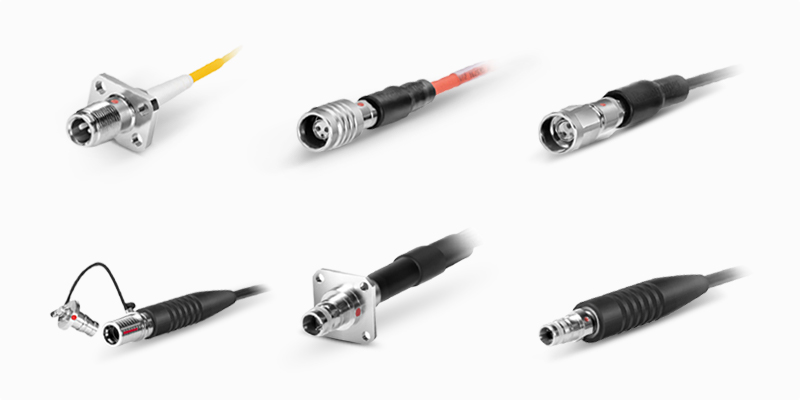
Q-RMC, short for Rosenberger Multifiber Connector, is a novel and robust industrial connector with an MTP®/MPO connector’s multi-core MT ferrule, accommodating 24 fiber cores. This compact connector includes a push-pull locking mechanism, making optical connections simpler and faster even in narrow spaces, thereby reducing installation time and related costs. The Q-RMC connector meets IP67 protection requirements, providing waterproof, dustproof, and corrosion-resistant features. Additionally, due to the Q-RMC connector’s operating and storage temperature ranging from -40 to 80℃, it is suitable for use in extreme temperature areas. Therefore, Q-RMC connector cables are suitable for industrial sites, mining areas, mobile communication (FTTA), 5G base stations, broadcasting, smart grid wiring, and more.
Rosenberger NEX10 Connector
The Rosenberger NEX10 connector is designed for harsh outdoor environments, featuring a compact size, waterproofing, dustproofing, and corrosion resistance. This connector type supports both screw-type and push-pull locking mechanisms. The push-pull quick lock ensures a secure installation and allows easy disassembly without any tools. For screw-type connectors, a screw locking mechanism is suitable for maintaining a firm connection between the plug and socket.
Fiber Quantity: Simplex and Duplex Fiber Optic Connectors
Simplex Connection: Signals are sent in one direction without return. The signal is transmitted from device A to device B through two simplex connectors and a simplex fiber cable, with no return path from device B to device A.
Duplex Connection: Duplex connectors and duplex fiber cables, known as duplex connections, allow signals to travel in both directions. Typically, a duplex cable is a duplex connector connecting two optical fibers.

Single-mode and Multi-mode Fiber Optic Cables
Currently, some connectors can simultaneously support both single-mode and multi-mode fiber optic cables, such as SC, LC, and FC, among others.
Connector Length: Standard Length and Short Length
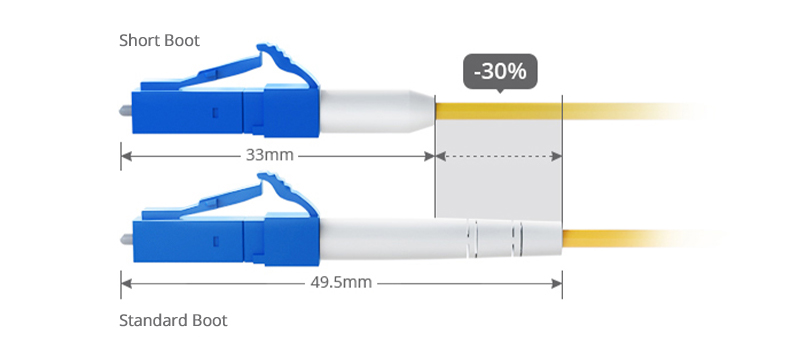
While their functions remain the same, short-length connectors are more suitable for specific scenarios, such as locations with limited space.
Polishing: APC/PC/UPC Fiber Optic Connectors
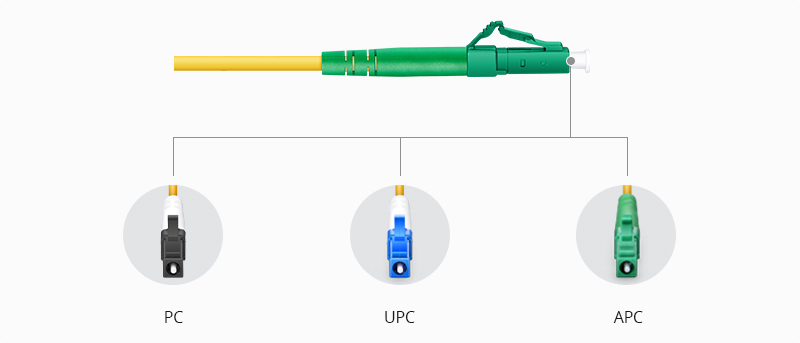
Fiber optic connectors are classified into three types based on polishing: PC, UPC, and APC.
They are identified by different colors, and polishing affects the loss of insertion and return loss.
Reference
Fiber Optic Cable Types: Single Mode vs Multimode Fiber Cable